
Oil as Death v2
Again: oil is dead, oil is death, but is oil dying?
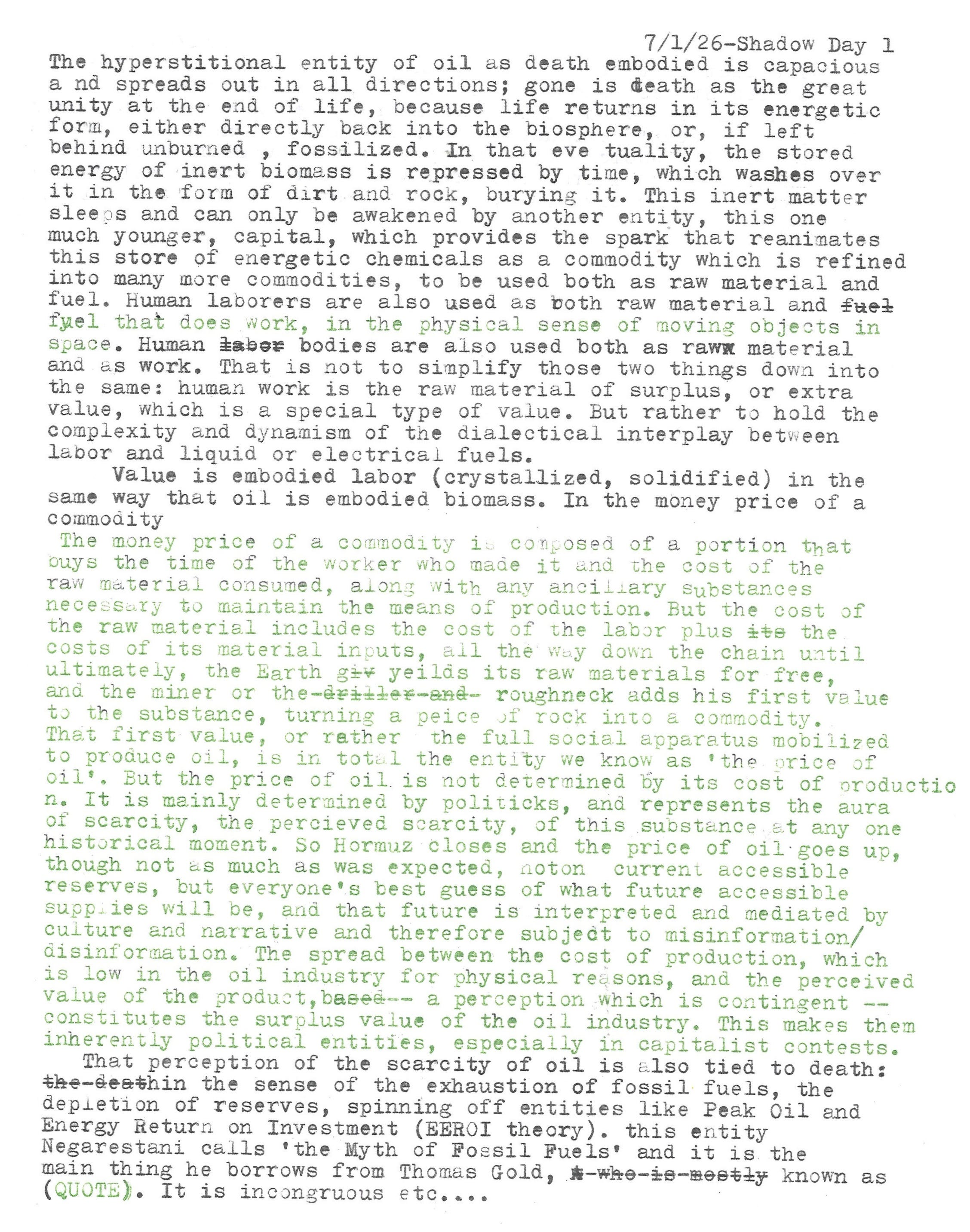
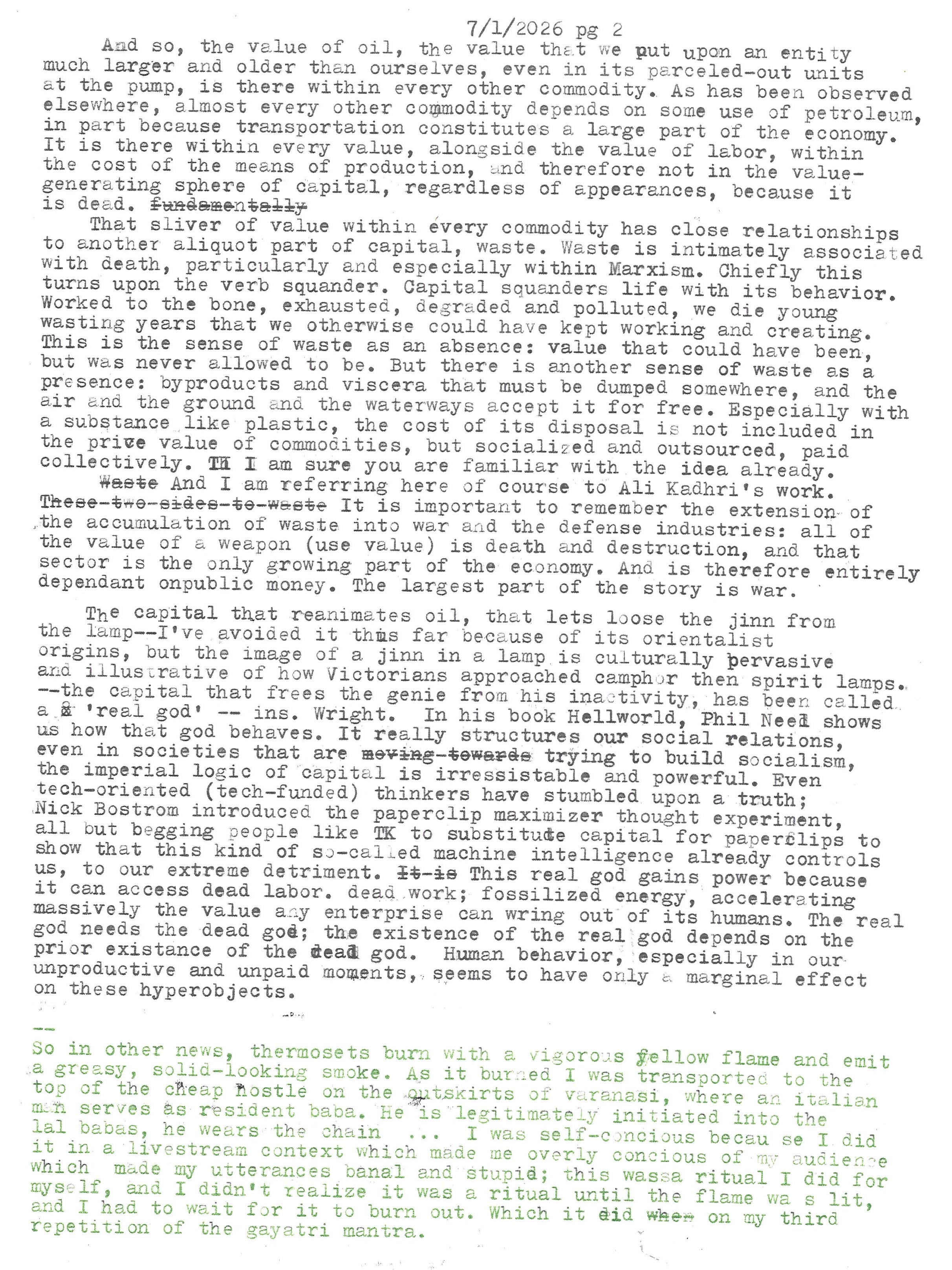
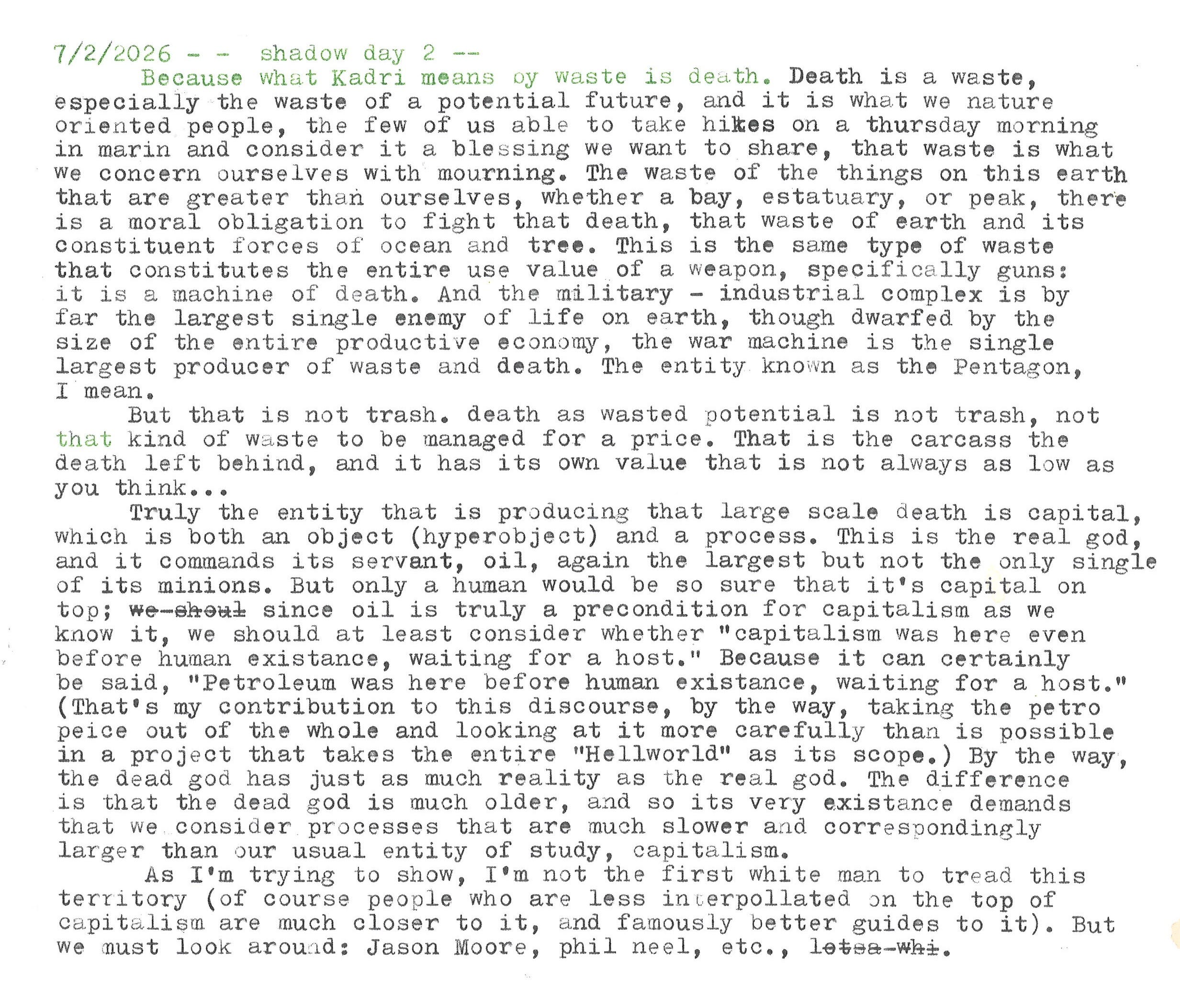
I haven’t seen other substacks post multiple drafts of the same essay, but I do it with some frequency. I’m not maintaining a newsletter, I’m writing a book in public, and my process requires multiple rewrites. That means that I took the previous version back to my typewriter, spent a couple days in the woods with the machine, and then brought it back to the computer and re-wrote everything from the typed pages. That doesn’t mean it has fewer typos and mistakes; it probably means more. I’ll include my scans of the types and you’ll see that it’s quite different again from either computer version. For me, the delete key changes writing entirely and fundamentally. I am not trying to imply that it’s actually worth your time to compare versions; I’m just dumping it in your lap and leaving it up to you. Presumably some of you didn’t read the first version, and plus there’s four new subscribers, ya’ll can hit it fresh. If you read the first post and are still interested, I think it could still be worth your time to read the next version: things have changed. This is only the second draft, and now I have a real human editor (Hi Jacob-squared), so it’s not going to be what’s in the final. It might not even be close. Or it might be cut. Writing is messy. LMK if you enjoy the visibility into my process, or this is all quite TMI.
The hyperstitional entity of oil as death embodied is capacious and spreads out in multiple directions; gone is death as the unitary resolution of life, because energy returns, either directly back to the biosphere, or, if left behind unused, fossilized. In that latter eventuality, biomass and the chemical energy it contains is repressed by time, which washes over it in the form of dirt and rock, burying it. Thus it becomes inert, trapped, and can only be awakened by another entity, this one much younger, capital. The story of Aladin is to be approached critically because of its orientalist origins, but it reveals how Victorians approached their camphor and spirit lamps. In this case, capital re-animates this store of flammable biochemicals and refines it into a multiplicity of commodities, which are then processed into yet more commodities, which are used either as raw material or as fuel—used to perform work, in the physical sense. Incidentally, human workers are also used either as raw material or as work. That is not to reduce these two different things down into one; only human work can produce new value, or surplus value, which is a special type of value. Rather we must seek to hold the complexity and dynamism of the dialectical interplay between labor and exosomatic work.
“Value is dead labor” (Marx) in the same way that oil is dead biomass. The exchange value (price) of a commodity is composed of a portion that buys the time of the worker who made it, and the cost of the raw material, ancillary substances, and all the other fixed costs of the means of production. But the cost of the means of production (including the raw material) is comprised of the cost of its constituent labor plus material inputs, all the way down the chain until you arrive at the extractive industry, wherein the earth yields its raw materials for free, and the miner of the roughneck adds his first value to the substance, turning a piece of earth into commodity. The social value of that labor yields the entity we now know as “the price of oil.” But the price of oil is not determined by the roughneck’s wages, but rather primarily by politics. Traditionally, the price of oil is determined by its perceived scarcity, and now today, by its perceived future scarcity, at any one historical moment. The aura of scarcity is interpreted and to some degree created by culture, narrative, and power, and therefore subject to disinformation. The spread between the cost of production, which is low in the oil industry for physical reasons, and the perceived value of the product—a perception which is contingent—constitutes the surplus value of the oil industry, or its profitability. This makes oil firms inherently political entities, especially when they remain under private ownership.
The perception of the scarcity oil is tied to death, in the sense of the exhaustion of fossil fuels, the depletion of reserves, spinning off entities like Peak Oil and Energy Return on Investment (EEROI) theory. This is why Negarestani discusses “The Myth of Fossil Fuels” as a feature of the hyperstitional entity of oil as “hydrocarbon corpse juice: A post-apocalyptic entity composed of organic corpses flattened, piled up and liquidated in sedimentary basins (mega-graveyards); geologists suggest that if a high sedimentation rate preserves organic material, a catastrophic sedimentation rate (The Flood) would uproot, kill, and bury organic material so rapidly as to cut the porphyrin off from oxidizing agents which would destroy them in the ocean water. Oil as the post-mortem production of organisms is bound to death. Since its ethos – both origin and end – is purely teleological, whatever it inspires is founded on death and the logic of death and eventual conclusion.”
This part is necessary to frame much of the historical narrative in my book, so I’ll go through the passage while offering my gloss as we go:
“Oil as hydrocarbon corpse juice[…] is a deity connected to what Thomas Gold calls ‘the Myth of Fossil Fuels’ or the exhaustible oilfields.”
On the surface, it is incongruous to bring Gold into the context of hydrocarbon corpse juice, because Thomas Gold believed it is hydrocarbon rock juice [see appendix]. But the Myth of Fossil Fuels is not about the origins of oil; it is about the end of oil. The myth of fossil fuels is that they will run out. Whether biotic or abiotic, oil on this earth is finite, like anything else, and so it’s a conceptually easy case to make. But just because it is finite does not mean that it is on the verge of exhaustion. These two are routinely conflated by peak oilers; the common sense that nothing lasts forever is mobilized to hide the total size of the entity in question. There are 1.85 octillion tons, otherwise known as billion gigatons (10.85 x 1027 tons) of carbon on earth, and 99% of it is below the surface, mostly in the crust.[i] If all of that were recoverable as fuel, it would take us 48.68 million years to burn at the current rate.[ii] Not all of it is recoverable, but the recoverable proportion is historically contingent. It can fluctuate dramatically based on political and technological circumstances, most particularly the pricing mechanism. Perceived scarcity drives up prices, which makes it possible to extract more and more carbon. Ironically, there is less oil economically recoverable when the price is low than when the price rises. The oil creates its own supply. The reserves that oil companies report—booked reserves—is not at all a representation of the actual quantity of oil and gas available, even available specifically to markets in a given moment. But the myth of fossil fuels is vital to oil’s perception and power., and so Negarestani continues:
“Pathological symptoms effectuated by the myth of fossil fuels can be summarized as:
i. The policy of underdevelopment and deliberate impoverishment bound to the exhaustible oil fields: Since oil is dying we must use it wisely and calculatedly (the fallacy of prudent poverty).”
This is a lesser symptom, but it is audible when liberal environmentalists chastise third world nations for opening up new oilfields to concessions. They are not wrong that we need to leave the oil in the ground, but capitalism cannot imagine a way to do so that doesn’t interfere with a nation’s sovereignty. In this way, the myth of fossil fuels becomes a moral weapon to deploy against nonwhite nations. Continuing:
ii. “Inhibition of Excess and inherent suppression (connected to the moralization of the earth aka the Green Judgement).”
This is the politics of the COPs, in which developed countries are supposed to cajole the global south, which includes oil producing countries, into limiting their own economic development. This pits race against race, nation against nation, and so avoids an actual class conflict in which workers would be fighting for the future against the ownership class. The co-opted ‘moralization of the earth’ is historically specific and is not a critique of the moral qualities of the earth that are understood by indigenous traditions.
iii. “Socio-political programming of planetary systems based on the depletion of petroleum. Everything oily has been manufactured with and toward death.”
The cyclical periods of market scarcity of oil and gas are programmed into the system, in the same way that serial killers are understood as “programmed to kill” by Dave McGowan. All periods of scarcity, when the energy industry enjoys a bull market, are manufactured by some political circumstance. Sometimes it is intentional on the part of the investors and companies that constitute the energy industry, we saw in 2022 with the escalation of the war in Ukraine (covered in this book), or it can occur as a result of other historical processes, as in the case of the 2026 Hormuz crisis. Petropolitics in a narrow sense can be seen as the process of manufacturing scarcity out of a geologically ample supply. In other words, sabotage. In citing Thorstein Veblen, Timothy Mitchell writes, “profits far exceeding the earning capacity of invested assets flowed from the ‘power of inhibition’ exercised by large businesses. This ‘capitalisation of inefficiency’ was especially profitable with a commodity such as oil, which was relatively cheap to produce but becoming so vital to industrialised society that great profits could be made if the supply was restricted. The goal of oil companies was to place themselves in control of the conduits, processing points and bottlenecks through which oil had to flow, to restrict the development of rival channels, beginning with oil wells themselves, and to use this command of obligatory passage points to convert the flow of oil into profits.”[iii] Negarestani concludes his list:
iv. “Fueling economic systems on monotheistic platforms through melding with their belief systems and apocalyptic politics: the exhaustion of the Earth’s aqua vitae is a prerequisite for the Rise of the Kingdom. God can only appear (reveal itself) when all possibilities of the Earth are depleted. The Myth of Fossil Fuels is connected to the institutionalization of religious expectation and anticipation through the oil industry: with every thing we produce with oil, we get a little closer to God. The enigma of oil consumption or the exhaustion of the earth’s energy is consummated by a substitute energy source, the Divine’s absolute power. Oil depletion scenarios can be connected to a chronological time for which anticipation is not only a premature conclusion but also a participation in attaining what is anticipated, either through the activity of hope or the passivity of despair.”
The sects most closely associated with the oil industry have been Evangelical Christianity and Wahhabi Islam. Both are eschatological and fundamentalist formations within much more expansive monotheistic religions. Both support and mythologize the apocalyptic project, and therefore the Zionist project in Palestine, which promises the apocalypse with its “Sampson option.” That Wahhabis and Evangelicals are considered to be extremist and fundamentalist illustrates the process by which oil has made the marginal central. It has done this by generating an anti-humanist elite class more powerful than humans themselves. For a sociological description of how that unfolded in America, refer to Darren Dochuk’s book, Anointed with Oil: How Christianity and Crude Made Modern America.
Negarestani and Gold’s “Myth of Fossil Fuels” isn’t the only myth about fossil fuels (I tell some others in this book). But it is perhaps the myth that is most important to liberal environmentalism, which conflates and confuses the problems of resource depletion and pollution. Both depletion and pollution (contamination) causes of death, and types of death.
That is how it came to be that the value of oil—a value determined by the percieved scarcity of oil or the Myth of Fossil Fuels—became a part of the value of every other commodity. As has been observed elsewhere, including by the energy industry itself,[iv] almost all production depends on petroleum at various points in its supply chain. So the value of that oil is reproduced as an aliquot part of the value of everything. However, it resides within the constant or fixed portion of value that represents the means of production, and so it does not generate more value by itself. It is dead value. And as such, has a close relationship to the value of death, which is what Ali Kadri means when he uses the word “Waste.”
Waste is intimately associated with death, particularly within the Marxist tradition. This goes back to Marx, for whom premature death could be counted as a waste of productive labor. The capitalist constantly seeks to maximize his surplus value by replacing variable capital (wages) with as little fixed capital as possible; this has forced rapid techological change as well as the environmental and social degradation which results in death. And so the waste itself is profitable to the capitalist as long as it shifts money away from wages.[v] “The working population therefore produces both the accumulation of capital and the means by which it is itself made relatively superfluous; and it does this to an extent which is always increasing.” [vi] The clearest connection of death to waste comes mediated through the verb “squandering” in this passage in Marx: “More than any other mode of production, it [capitalism] squanders human lives, or living labour, and not only blood and flesh, but also nerve and brain. Indeed it is only by dint of the most extravagant waste of individual development that the development of the human race is at all safeguarded and maintained[…]”[vii] Worked to the bone, exhausted, degraded, and polluted, we die young, leaving a certain part of our potential value unrealized. This is the same type of waste that constitutes the entire social value of weaponry, of guns: machines whose product is death. And so the entity known as the Pentagon is by far the largest single enemy of life on earth, though perhaps dwarfed by the size of the entire body of capitalism.
But the two meanings of the word “waste” must be held in the complexity of a dialectic process. Waste is not only a squandering, it is also trash. A category of material that can be piled, dumped, burned, traded, recycled, and so on. A life wasted by capitalism is an absence, a bargeload of trash sailing from Manhattan to Fresh Kills is a presence – but these two types of waste flow into and round each other. The cost of this type of waste is not paid either by producer or consumer, but is socialized amongst all of us; the air and the ground and waterways accept it for free, and our bodies re-absorb it, degrading our health. The horizon of waste spans two extremes: a total depletion on the one end—a void where life ought to be—and a total corruption on the other. Both are forms of death.
Death that is animated by capital. Marx teaches us how to dialectically simplify a complex process into its most basic formula with money – commodity – money1, which constitutes the productive engine that, along with other things, keeps oil in motion from underground through the market and into combustion chambers. The biosphere’s corresponding formula could be—at least in part—Life – Death – Life1, where L1 is a lower energetic value than L, because energy has gotten lost since quite a bit of the original life didn’t get eaten. Oil’s formula would be inverse, Death - Capital -Death1, where D is the collected leftover energy that was buried by ancient biological processes, and D1 is the collective catastrophe of climate change, the tellurian omega. Each element in these formulas; life, death, capital, money – is not a static thing but itself represents a process, a particular movement.
Speaking cybernetically, each of these loops constitutes a control mechanism, or a negative feedback loop that maintains a complex system within certain boundaries, even if those boundaries are rapidly accelerating: capital in particular is a mode of social organization and reproduction that constitutes the entire horizon of our lives. Within its logic, the capitalist has no more free will than the worker. Ian Wright calls our attention to a passage in Marx’s 1844 private notebooks (“Comments on James Mill”), with the emphasis in the original:
“The essence of money is not, in the first place, that property is alienated in it, but that the mediating activity or movement, the human, social act by which man’s products mutually complement one another[…] Owing to this alien mediator – instead of man himself being the mediator for man – man regards his will, his activity and his relation to other men as a power independent of him and them. His slavery, therefore, reaches its peak. It is clear that this mediator now becomes a real God, for the mediator is the real power over what it mediates to me. Its cult becomes an end in itself. Objects separated from this mediator have lost their value. Hence the objects only have value insofar as they represent the mediator, whereas originally it seemed that the mediator had value only insofar as it represented them. This reversal of the original relationship is inevitable. This mediator is therefore the lost, estranged essence of private property, private property which has become alienated, external to itself, just as it is the alienated species-activity of man, the externalised mediation between man’s production and man’s production. All the qualities which arise in the course of this activity are, therefore, transferred to this mediator. Hence man becomes the poorer as man, i.e., separated from this mediator, the richer this mediator becomes.”[viii] [emphasis in original]
In these private moments, Marx understood capital as a “real god.” Angus writes that “at the apex of the economy we have a competing collection of identical controllers—with an atavistic, low level of demonic intelligence—which inject and withdraw a social substance that appears to possess the magical power of animation, of bringing things alive, of creation; but also appears to possess the power of annihilation, of suffocation, of bringing things to an end, of destruction.”[ix] Capital injects and withdraws and commodity flows grow or shrink in response; as a single commodity, as important as it is, oil is only a portion of this system, the whole of which comprises the egregore known as the economy.
But considered on its own, as a geologist or engineer, oil is its own entity no less (and maybe more) real than capital, endowed with a massive prehistoric power that dwarfs human potential, another real god, but this one dead. Inert, dormant, buried in the earth. Until it is animated by capital, and then in turn animates technology, which appears to animate the entire economy. Its value represents only a small portion of the total capital of society, and yet its flow is foundational and essential to all other productive activity; it is the commodity that rules all other commodities, and is an aliquot part of the value of all other commodities. And yet its value can never generate more value, since it sits in the “constant capital” side of the Marxist economist’s ledger, since it is work as a means of production rather than work as human labor. It is a dead part of the real god, but an important one: without fossil energy, capital could only have taken an unimaginably different path to global domination, so unthinkable that we have to consider the veracity of Negarestani’s aphorism, “Capitalism was here even before human existence, waiting for a host.” Since that is certainly true of oil.
Calling these entities gods serves to emphasize their capacity for control. We do not control capital: we are controlled by it. A human being may be many things—a parent or a poet or a pirate—but before the real god they are only either a worker or a capitalist. A capitalist’s only purpose is to valorize capital, and no matter how much he might, in his private life, value the rights of workers or of the earth, when he is at work he must placate his one true deity.
As Phil Neel reminds us, that does not mean that our resistance is meaningless. “But even though the magisterial terror of such an image [capital as god] is alluring, an overemphasis on the alien, autonomous, and domesticating force of capital easily inverts reality by making the ‘automatic subject’ of capital into the sole driving force of history. It is no coincidence that critics often accuse those who invoke this image (especially Moishe Postone, in his Time, Labour and Social Domination of offering a theory of capital evacuated of class struggle.”[x] The class struggle itself is dialectically inevitable given the logic of capitalism, but that doesn’t predetermine history; the struggle is subject to our tactical and strategic decisions.
But now the dead god does predetermine future history—it has created a certainty that the energy imbalance of the earth will grow, that the atmosphere and oceans will become hotter and hotter, and that excess energy will be expressed in more and more violent whether events. It will kill everyone eventually, but before it does, it will hurl disaster after disaster at us; we’re only at the beginning of that process. Again, that doesn’t make our resistance meaningless. It means that oil is connected to death so strongly that all petropolitics are teleological. (Of course not all carbon emissions are directly released by the single entity Oil, but the conditions for land use change, industrial agriculture, and so on, are all themselves dependent upon cheap oil). Petrohistory begins at its end, even if it’s just the beginning of the end today: a world accelerating into a cascading catastrophe that will spare nobody before it burns out. The stories in this volume are more significant in retrospect than they were at the time, because they collectively represent the means by which our species, and many others besides, will have been murdered. You are reading from the end, and I hope to tell you how we got there.
[i] This number 1.85 billion gigatons, was determined by the Deep Carbon Observatory in 2019. Jonathan Amos, “Scientists estimate Earth’s total carbon store” BBC, October 1, 2019. https://www.bbc.com/news/science-environment-49899039
[ii] Approximately 38 billion tons annually. https://www.statista.com/statistics/276629/global-co2-emissions/
[iii] Timothy Mitchell, Carbon Democracy: Political Power in the Age of Oil. London/New York: Verso, 2011, p40. Thorstein Veblen, ‘On the Nature of Capital,’ Quarterly Journal of Economics 23:1, 1908, p104-136
[iv] See the “Life Runs on Energy” campaign by Energy Transfer from 2021,
[v] [v] Ali Kadri, The Accumulation of Waste: A Political Economy of Systemic Destruction. Leiden: Brill, 2023.
[vi] Marx, Capital vol. 1, 783. (“The General Law of Capitalist Accumulation” section 3)
[vii] Marx, Capital vol. 3, Chapter 5 section 3, cited in Kadri p1-14
[viii] Karl Marx, “Comments on James Mill, Éléments D’économie Politique” 1844
https://www.marxists.org/archive/marx/works/1844/james-mill/. In Ian Wright, “Marx on Capital as a Real God” September 3, 2020 https://ianwrightsite.wordpress.com/2020/09/03/marx-on-capital-as-a-real-god-2/ in Phil A. Neel, Hellworld: The Human Species and Planetary Ecology. Chicago: Haymarket, 2026.
[ix] Ian Wright in Phil A. Neel, Hellworld: The Human Species and Planetary Ecology. Chicago: Haymarket, 2026.
[x] Neel, p114-115.
well done.